
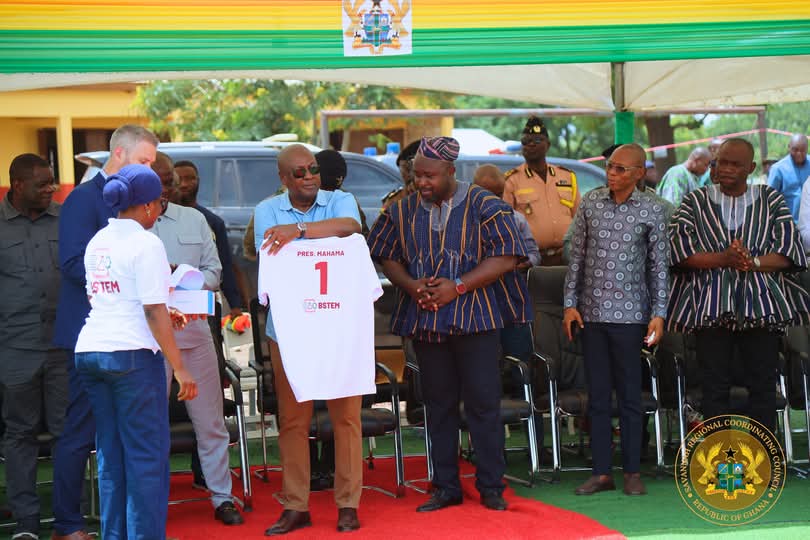
President of the Republic of Ghana, John Dramani Mahama, engaged pupils of Sawla D/A Primary and JHS as they demonstrated practical B-STEM skills during his Resetting Ghana tour of the Savannah Region on Friday, 22nd May 2026.
The President was joined by Haruna Iddrisu, Savannah Regional Minister Salisu Bi-Awuribe, Savannah Regional Education Director Mr. A. Lawoe, NDC party leadership and supporters, as well as students from different levels across the Sawla-Tuna-Kalba District. The visit formed part of efforts to assess the implementation and impact of the nationwide B-STEM Project in schools.
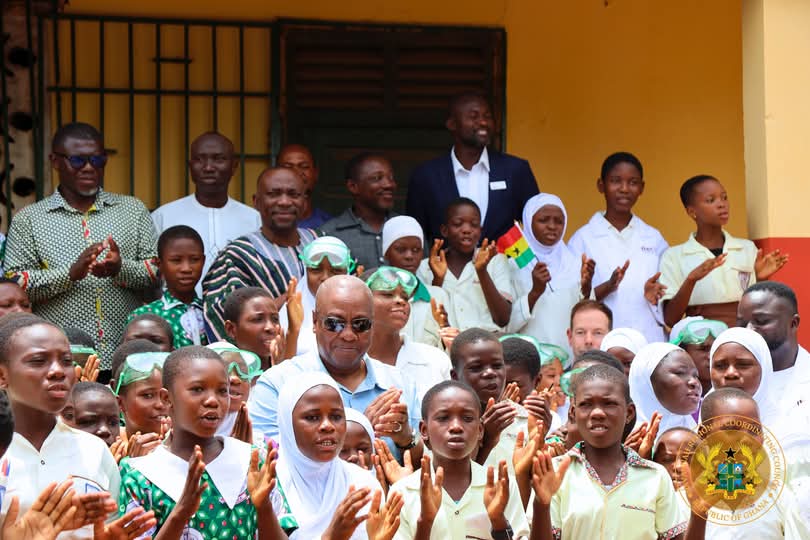
During the engagement, President Mahama reiterated government’s strong commitment to transforming basic education through a practical, interactive and inclusive Science, Technology, Engineering and Mathematics approach. He noted that the integration of robotics, coding and artificial intelligence into classroom teaching is equipping young learners with critical thinking, creativity and future-ready skills needed to thrive in a rapidly evolving technological world.
Students of Sawla D/A JHS impressed the President and his entourage with practical demonstrations using modern STEM equipment, showcasing improved understanding of science and mathematics through hands-on learning activities. The President and the Education Minister observed first-hand the impact of the B-STEM Project, describing it as a landmark national initiative that continues to strengthen STEM education at the basic level across Ghana.
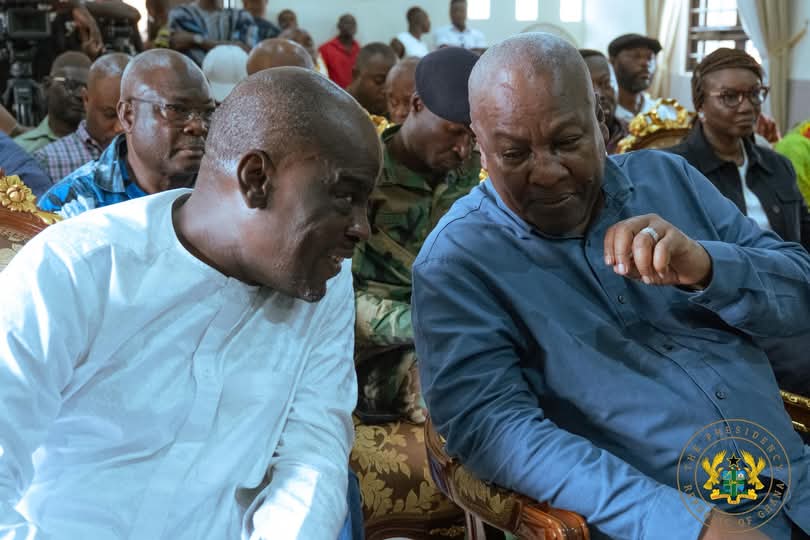
The B-STEM Programme—Basic Science, Technology, Engineering and Mathematics—is a major government intervention aimed at revolutionising STEM education in Ghana’s primary and junior high schools. The programme is shifting learning away from rote memorisation toward inquiry-based, practical learning by providing schools with science kits, digital devices, projectors, laptops and laboratory resources.
So far, the project has supported 3,518 junior high schools and 1,432 primary schools nationwide with modern STEM equipment. Additionally, 6,382 JHS science and mathematics teachers have received specialised training, while 50 Regional Advisors, over 520 JHS District Trainers, and 261 Primary District Trainers have been trained to support implementation across all districts.
The initiative’s core objectives include strengthening STEM infrastructure, building teacher capacity, promoting experiential learning, integrating AI, robotics and renewable energy concepts into the curriculum, and ensuring equitable access to quality STEM education in all 16 regions of Ghana.
The visit to Sawla highlighted government’s continued investment in education and its determination to prepare Ghanaian children with the knowledge and practical skills needed to compete in a technology-driven future.
Abdulai Zulkaninu